
Chemical Characterisation of Pre-Filled Syringes: A Focus on Extractables and Leachables
Our analytical chemistry teams support pharmaceutical and medical device manufacturers with complete extractables and leachables (E&L) studies in accordance with ISO 10993 and USP requirements. This article by James Silk, Senior Analytical Chemist, published in Pharmaceutical Manufacturing and Packaging Sourcer (PMPS) Autumn 2025 edition (pages 17-19), explains how E&L testing for pre-filled syringes is performed and what information is needed to ensure accurate, compliant results.
Almost all medical devices that are patient contacting either directly or indirectly require extractables and leachables (E&L) testing. Pre-filled syringes are an example of a combination device, medical devices that contain a drug product. Leachables assesses the chemicals that migrate from the syringe into the drug product in a simulated worst-case scenario. Extractables assesses the chemicals that migrate from the syringe into various polarity solvents under exaggerated conditions.
Continue reading the paper below:

Author:

James Silk
Senior Analytical Chemist at Cormica, specialises in extractables and leachables (E&L) testing for medical devices and combination products. With expertise in GC-MS and LC-MS techniques, James supports regulatory submissions through method development, validation, and interpretation of E&L data for global clients.
Share with your colleagues:
Device Information
Every medical device that requires chemical characterisation of their extractables and leachables is different in some aspect that has an impact on how an E&L study is planned, or the results at the end. Information received before testing can reduce the time it takes to complete a study, because known incompatibilities and expected results can be anticipated. Therefore, gathering information about the medical device that requires testing is very important. Below is a list of information that can be gathered and how they can aid an E&L study:
Construction Materials:
Information such as chemical composition, certificates of analysis, technical/product data sheets, safety data sheets, material types and specifications can help identify potential extractables and leachables. This information is essential for selecting appropriate reference standards and compatible solvents. Choosing medical grade plastics will yield fewer extractables and leachables.
Specific Compounds of Concern:
Some compounds are highly toxic, meaning even very low levels, potentially below the Analytical Evaluation Threshold (AET), can pose a risk. Targeted analytical methods can be developed specifically for these compounds, allowing for more sensitive and accurate quantification than non-targeted screening methods.
Duration, Nature, and Recipient of Contact:
The type of patient contact (limited, prolonged, or long-term), frequency of use (continuous vs. intermittent), mode of contact (surface, implant, infusion), and patient population directly influence the type and duration of extractions. This information is used to determine the AET and toxicological risk assessment strategy.
Manufacturing Processes:
Processes such as moulding, sterilization, or cleaning may alter the chemical profile of materials or introduce additional residues. Understanding these processes helps in designing analytical methods that can detect possible process-related impurities or degradation products.
Device Measurements:
The device’s internal and external surface areas are required to determine the appropriate extraction container size and solvent volume for full immersion, in accordance with ISO 10993-12 1.
Active Pharmaceutical Ingredients (APIs):
When the drug product is supplied with the device, the identity of the API and analytical characteristics should be confirmed on the methods before E&L testing to avoid misidentification as an unknown compound. Additionally, known or expected degradants of the API can be considered.
Cormica’s scientists work closely with clients during this early phase to ensure all relevant device information is captured, helping to streamline study design, minimise rework, and accelerate reporting timelines.

Extraction Conditions
Leachables Studies: Simulating Real-World Storage Conditions
Leachables testing for pre-filled syringes evaluates which chemical constituents may migrate from the syringe materials into the drug product over time. Interactions between the drug formulation and the syringe components can impact the efficacy, physical integrity, safety, and stability of the API. Leachables studies are performed under simulated storage conditions that reflect the product’s intended shelf life. These may involve real-time or accelerated storage conditions, depending on the study design. The drug formulation is analysed at regular intervals throughout the storage period e.g. every 3 months for a product with a shelf-life of one year. Formulations commonly include water, ethanol, propylene glycol, or glycerin mixtures, all of which can influence the leachables profile due to their varying solvent properties.
Extractables Studies: Designing Exaggerated Test Environments
Extractables testing, on the other hand, is conducted in the absence of the drug product. The syringe is exposed to both a polar and a non-polar solvent under exaggerated conditions, involving elevated temperatures and extended durations (e.g. 50°C for 72 hours). These conditions are designed to force the migration of extractable compounds from the syringe materials into the solvent. The volume of solvent used is determined by the surface area of the patient-contacting components of the syringe and must be sufficient to allow full immersion.
Replicates and Controls in E&L Study Design
E&L studies are recommended to be performed in triplicate for each condition and time point to account for variability between devices. Control samples, consisting of only the extraction solvent stored under identical conditions, are included to distinguish background contaminants from device-related compounds.
Prior to testing, feasibility studies must be conducted to confirm that the selected solvents do not degrade or compromise the integrity of the syringe. Material degradation can produce artifacts or false positives, potentially leading to inaccurate or misleading extractables profiles.
Our laboratories are equipped to perform both extractables and leachables studies under controlled GMP conditions, using validated methods and storage environments to replicate real-world product use.
Analytical Techniques
Analytical Methods Used for Extractables and Leachables Testing
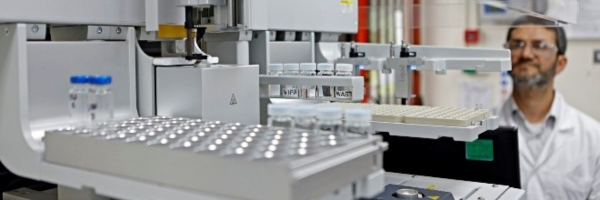
The drug formulation and solvents recovered after extraction are analysed using a variety of analytical instruments to cover the full range of potential extractables and leachables that could arise from the medical device in accordance with ISO 10993-18 2. The main categories of extractables are inorganic ions, non-volatile organic compounds (NVOCs), semi-volatile organic compounds (SVOCs) and volatile organic compounds (VOCs).
Identifying Volatile and Semi-Volatile Compounds by GC-MS
Gas Chromatography Mass Spectrometry (GC-MS) is used to separate and detect SVOCs and VOCs. During analysis, the extract is injected into a heated inlet where it is vaporised. The vaporised sample is then carried by an inert gas through the column, where individual compounds are separated by their boiling points and affinity for the stationary phase. As these compounds elute from the column, they are detected by the mass spectrometer, generating a chromatogram. Non-aqueous extracts are suitable for direct injection. However, aqueous extracts require additional sample preparation or specialised sampling techniques to be compatible with GC-MS analysis.
One such technique is Solid-Phase Microextraction (SPME), which uses a coated fibre to adsorb SVOCs and VOCs from the sample matrix or headspace before thermal desorption into the GC inlet. Importantly, water is not retained by the fibre, minimising the risk of introducing moisture into the system and preventing potential damage to the GC-MS instrument.
Headspace Gas Chromatography Mass Spectrometry (HS-GC-MS) can also be used to detect VOCs in aqueous extracts. The sample is heated to promote the volatilisation of any VOCs present into the headspace. The gas phase is then sampled and injected into the GC-MS. Aqueous extracts are well-suited for this, as water has a relatively high boiling point, higher than the temperature that the extracts are heated to. Organic solvents such as ethanol and hexane have lower boiling points, which can result in large, interfering solvent peaks on the chromatogram that may obscure VOCs released from the device.
Analysing Non-Volatile Compounds Using HPLC
High-Performance Liquid Chromatography (HPLC) is used to separate and detect NVOCs and SVOCs when coupled with a mass spectrometer (MS) or other suitable detectors. In reverse-phase HPLC, the extract is injected into a stream of mobile phase, which carries the sample through a column packed with a non-polar stationary phase. Separation occurs based on the polarity of the compounds, as analytes partition between the more polar mobile phase and non-polar stationary phase depending on their chemical affinity. Non-polar extraction solvents are not compatible with reverse-phase HPLC.
Detecting Inorganic Ions with ICP and Ion Chromatography
Inductively coupled plasma (ICP) and ion chromatography are analytical techniques used to identify and quantify inorganic ions in aqueous extracts, which are suitable for direct injection into both instruments. ICP, commonly paired with optical emission spectroscopy (OES) or MS detectors, decomposes samples into their elements, ionizes them, and uses energy coupling to form plasma for analysis, primarily targeting metal ions. In contrast, ion chromatography focuses on anions such as halides, nitrates, and sulfates, separating them in the liquid phase via an ion exchange column and mobile phase gradients, with detection typically achieved through a conductivity detector.
Cormica’s analytical chemistry laboratories in the UK and US combine advanced GC-MS, LC-MS, ICP-MS and ion chromatography capabilities with deep regulatory expertise to support FDA, EMA and MDR submissions.
Data Analysis
Selecting Reference Standards and Calibration Curves
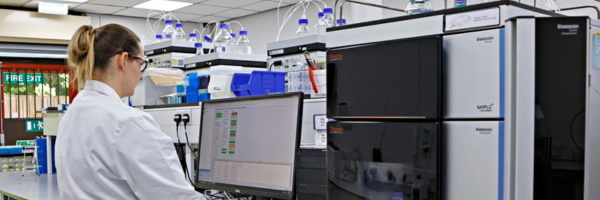
Reference standards should be selected based on the analytical methods used and the expected compounds or ions that may be released from the medical device. For each reference standard, a calibration curve must be generated by measuring its detector response across a range of known concentrations. These calibration curves are then used to quantify or semi-quantify compounds and ions detected in the extracts.
Quantification Using Relative Response Factors (RRFs)
In cases where individual calibration curves are not available for all analytes, quantification can be performed using relative response factors (RRFs). RRFs compare the detector response of an analyte to that of an internal standard at known concentrations, providing a practical alternative when analysing complex mixtures that may contain hundreds of potential compounds. By maintaining a library of RRFs, a higher proportion of peaks can be accurately quantified against appropriate reference standards, reducing the reliance on surrogate compounds. When neither a calibration curve nor a RRF is available for a detected peak, a surrogate standard is selected based on structural similarity, under the assumption that similar compounds will ionise in a comparable manner and produce similar detector responses.
Compound Identification and Data Interpretation
To account for background signals, peak areas with fragmentation patterns and retention times in control extracts are subtracted from those in the test sample chromatograms. Compound identification is then performed using spectral libraries, which contain information such as mass spectra, retention indices, and retention times, this data supports greater confidence in the proposed identifications. These tentative identities are reviewed by a scientist to assess their plausibility based on the materials and chemistry of the medical device. Once confirmed, the identified compounds are assigned appropriate reference standards or structurally similar surrogates to estimate their concentrations.
Learn more about our analytical services and see our full equipment list

Reporting Results
Applying Analytical Thresholds: LOD, LOQ and AET
Some peaks may be excluded from the reported results if they fall below defined thresholds: the Limit of Detection (LOD), the Limit of Quantification (LOQ), and the AET. The LOD and LOQ, which apply to all analytical methods, are typically defined as 3 and 10 times the signal-to-noise ratio, respectively. The AET, however, is specific to the device and extraction process and applies only to GC and HPLC methods, unless the compound falls into the “cohort of concern” category, in which case the AET does not apply. Compounds in this category are considered more toxic, and even low concentrations under the AET are assessed for their toxicity.
How to Calculate the Analytical Evaluation Threshold (AET)
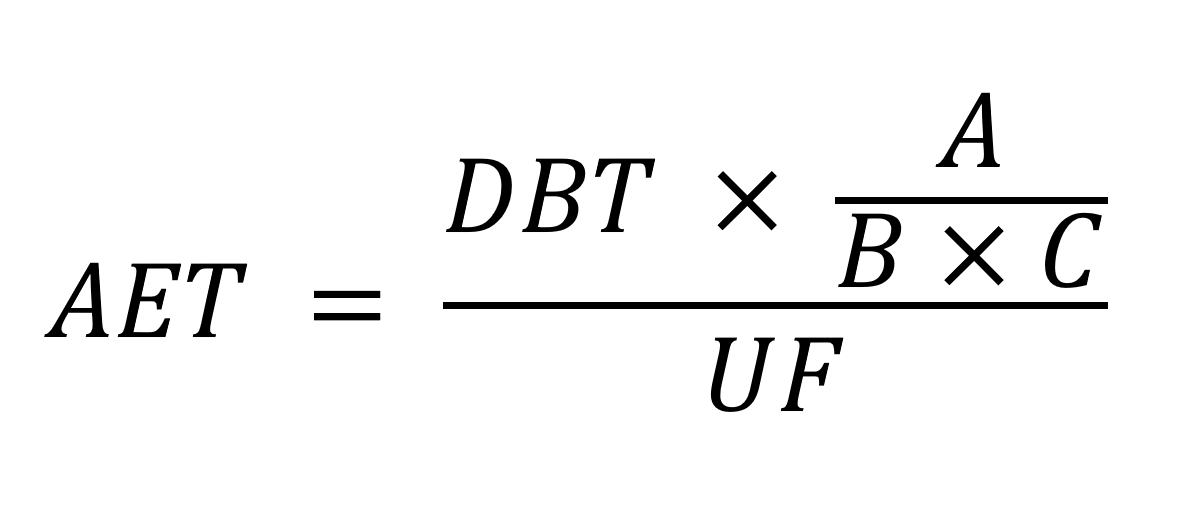
The AET is calculated using the equation:
Where:
- DBT is the Dose-Based Threshold from ISO/TS 21726 3
- A is the number of devices extracted
- B is the extract volume
- C is the number of devices used daily
- UF is the Uncertainty Factor, determined by statistical analysis of the response factors of reference standards for a specific method
Toxicological Evaluation and Regulatory Review
Following the application of these thresholds to the quantified or semi-quantified compounds or ions released from the medical device, a toxicologist evaluates the reported extractables and leachables to ensure they remain below toxicological safety limits for patient use. The toxicologist may recommend additional testing to assess specific toxicological endpoints.
Cormica delivers complete E&L study packages, from study design and material characterisation to toxicological risk assessment and final reporting. Our goal is to help clients demonstrate product safety, maintain compliance, and reach the market quickly.
To learn more about our extractables and leachables testing for pre-filled syringes and other combination products, contact our experts.
References
1. ISO 10993-12:2021 Biological evaluation of medical devices – Part 12: Sample preparation and reference materials
2. ISO 10993-18:2020/Amd 1:2022 Biological evaluation of medical devices – Part 18: Chemical characterization of medical device materials within a risk management process.
3. ISO/TS 21726:2019 Biological evaluation of medical devices – Application of the threshold of toxicological concern (TTC) for assessing biocompatibility of medical device constituents