




Plunger Stopper Movement in Pre-filled Syringes: Understanding the Risks and Testing Requirements

Pre-filled syringes are designed to protect the drug product and maintain sterility throughout storage, transportation and use. However, changes in pressure and temperature during the product lifecycle can affect the components within the syringe, including the plunger stopper.

Unintended plunger stopper movement can present a potential risk to the sterile barrier. Understanding how the stopper behaves under conditions such as reduced atmospheric pressure can therefore be an important part of product development and risk assessment.

Plunger Stopper Movement in Prefilled Syringes

Author:

Steven has over 10 years of experience in the medical device industry and is the Combination & Physical Devices Manager at Cormica MET. He is also a member of the Paternal Drug Association, contributing to the advancement of medical device guidance globally.

Share with your colleagues:

Facebook
Twitter
LinkedIn
Email
WhatsApp
Print

What is plunger stopper movement?

Plunger stopper movement testing assesses the behaviour of the stopper within a pre-filled syringe barrel when exposed to controlled low-pressure conditions.

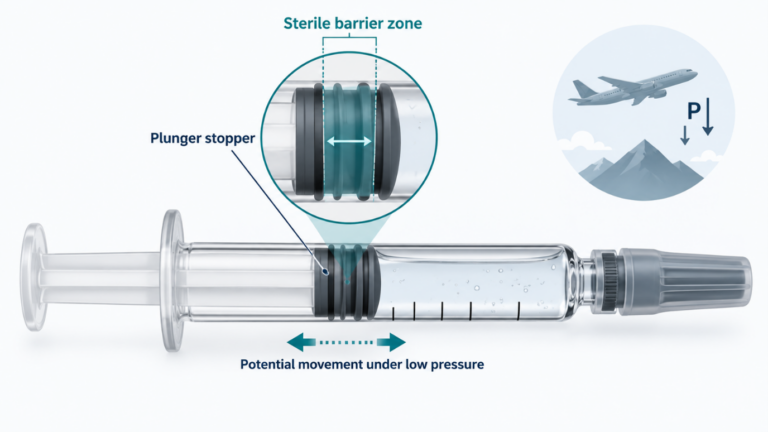
The plunger stopper forms a seal within the barrel, helping to maintain the integrity of the syringe. The sterile barrier zone is defined by the sealing region between the distal and proximal ribs of the stopper.

If external conditions cause the stopper to move significantly, its sealing surfaces may travel beyond the intended sterile barrier zone.

Why does plunger stopper movement matter?

Pre-filled syringes can experience changes in air pressure and temperature during storage and transportation, as well as forces introduced during assembly or changes associated with the drug product itself.

Pressure changes are particularly relevant for syringes containing a gaseous headspace, such as an air bubble. As external atmospheric pressure falls, the gas within the syringe can expand and exert additional force on the plunger stopper.

This may occur during air transportation, where packaged products can experience reduced atmospheric pressure.

If this causes excessive stopper movement, the sterile barrier may be challenged. Temperature changes, phase transitions and assembly forces can also contribute to unintended movement.

“Plunger stopper movement can be easy to overlook, but relatively small changes in pressure or temperature can have a significant impact on syringe performance. Testing helps manufacturers understand that behaviour early and assess whether the sterile barrier could be challenged under realistic transportation conditions.”

Steven Malbon, Combination & Physical Devices Manager

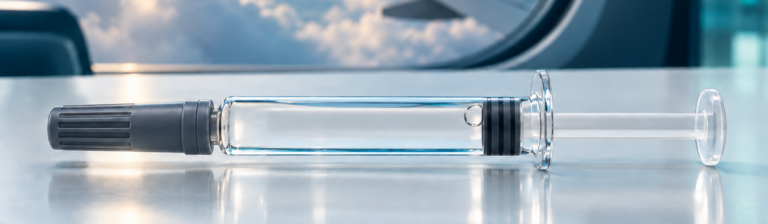
Cormica PFS Air transport hero

Which products may require testing?

Testing is primarily relevant to pre-filled syringes, particularly those containing a gaseous headspace or those expected to experience pressure changes during transportation.

Similar assessments may also be appropriate for cartridges, which use elastomeric stoppers to maintain container integrity.

The need for testing should be considered alongside the product design, headspace, component configuration, intended storage conditions and distribution route.

How is plunger stopper movement tested?

Samples are exposed to a controlled low-pressure environment that can simulate conditions experienced during transportation at altitude.

The position of the plunger stopper is measured at defined intervals throughout the test, allowing any movement to be monitored and quantified.

Testing can be performed under standard laboratory conditions or at reduced temperatures where cold-chain transportation is relevant. Study designs can also be adapted for different sample numbers, test durations and pressure profiles.

How do ASTM D6653 and ISO 11040-8:2026 apply?

ASTM D6653/D6653M describes methods for evaluating the effects of high altitude on packaging systems using reduced pressure. A vacuum chamber is used to create a pressure differential between the product or package and its surrounding environment.

For pre-filled syringes, this type of controlled low-pressure exposure can support assessment of how altitude-related pressure changes affect plunger stopper position.

ISO 11040-8:2026 addresses requirements and test methods for finished pre-filled syringes. The 2026 edition includes consideration of unintended plunger stopper movement resulting from factors such as air-pressure changes, temperature changes, phase transitions and assembly forces.

While ISO 11040-8 identifies the issue, it does not prescribe a specific test method for assessing it. Manufacturers therefore need to determine an appropriate approach based on their product design and associated risks.

When should testing be considered?

Plunger stopper movement should be considered during design and development, when risks associated with the syringe configuration, drug product, headspace and intended distribution conditions are being assessed.

Testing may also be relevant following changes to components, fill volume, stopper configuration, manufacturing processes, storage conditions or transportation routes.

At Cormica, plunger stopper movement testing is UKAS accredited, with flexible study designs available to meet different product and programme requirements. Drawing on decades of physical and functional testing experience, our expert scientists support manufacturers in generating reliable data for pre-filled syringe development, verification and lifecycle activities.

Plunger stopper movement: key considerations

When assessing whether testing may be required, consider:

      • Does the pre-filled syringe contain a gaseous headspace?
      • Could the product experience reduced pressure during air transportation?
      • Could temperature changes affect internal pressure or product behaviour?
      • Is there a risk of the stopper moving beyond the sterile barrier zone?
      • Have the stopper, barrel, fill volume or other components changed?
      • Are cold-chain or extended transportation conditions relevant?
      • Has plunger stopper movement been considered within the product risk assessment?
        Could testing be combined with wider ISO 11040-8 functional and performance testing?

Understanding how the plunger stopper behaves under realistic environmental conditions can provide valuable evidence to support product development and help manufacturers assess risks to syringe performance and sterile barrier integrity.

Laboratories near you, supporting global product success

With accredited laboratories in the UK, EU and US, we support pharmaceutical, medical device and combination product manufacturers worldwide. Local support combined with global quality, delivered by teams who understand your regulatory requirements.

Cormica Award winning Testing laboratories
Cormica Global Map locations (1)

Our Clients’ Experiences

Contact our Experts
Please do not include links in your message. We do not test personal samples or provide medical diagnoses. Click here for Careers
Scroll to Top