
Case Study: Custom-Built Solution for NHS Standard Rotational Dye Ingress Testing
Home » Case Study » Case Study: Custom-Built Solution for NHS Standard Rotational Dye Ingress Testing
Container Closure Integrity Testing (CCIT) is essential in ensuring that medical devices and pharmaceutical packaging maintain a secure barrier against contamination. One common CCIT method is dye ingress testing, which evaluates whether a liquid product container allows potential unwanted contaminants to enter under specific conditions. While dye ingress testing is widely used, Cormica was recently presented with a unique challenge: perform the test in accordance with an NHS protocol that requires continuous rotation of syringe samples at a controlled speed.
This rotational method is not often requested and posed both logistical and engineering challenges. Cormica’s team responded with a rapid, bespoke solution that delivered accurate results and demonstrated our capability to adapt established methods for complex, custom projects.
Kristian Lawford
Kristian is a Technical Scientist working within the Physical and Combination Devices department at Cormica MET.
Share This Resource
The Challenge
The NHS protocol for syringe integrity testing specifies that samples must be filled with water, sealed under vacuum, submerged in dye, and rotated at 45 revolutions per minute for two hours. The dye must flow over all surfaces of the syringes, enabling potential ingress through any microscopic flaws in the plunger seal or hub connection.
The request required:
- A custom leak-proof vessel capable of holding multiple syringes and the dye solution, while fitting into a roller mixer for controlled rotation.
- An internal holder to secure syringes in place and prevent them from colliding or causing damage during testing.
- The inclusion of positive control samples to verify the test method’s validity.
The unique rotational requirement meant existing laboratory equipment was not suitable without significant modification.
Our Solution
The Cormica team designed and manufactured a bespoke test rig to meet the specific requirements of the protocol. The first step was creating a vessel, made from durable PVC, that was both watertight and compatible with the rotation drive. This ensured that samples could be fully submerged while being rotated at the required speed.
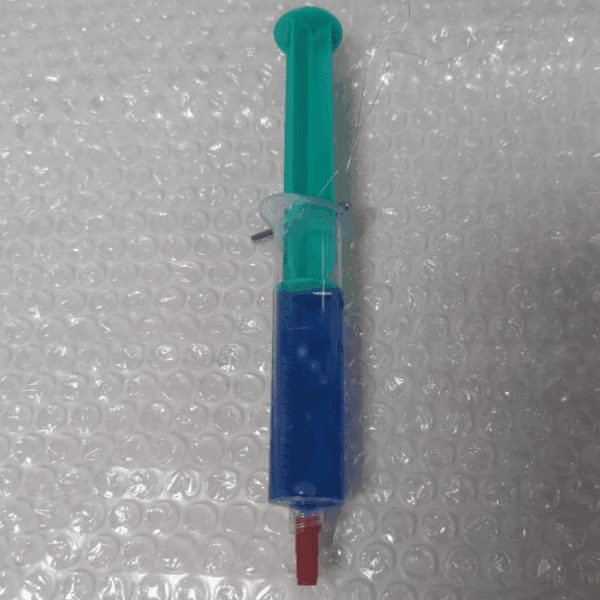
To prevent syringes from colliding during rotation, a custom 3D-printed holder was developed. The holder was designed to secure five syringes per run, four test samples and one positive control, and could be adapted in the future for different syringe sizes simply by adjusting the 3D model. This not only met the immediate need but also created a flexible tool for similar projects.
Positive controls were prepared by introducing a fine stainless-steel wire, just 0.12 mm in diameter, between the plunger seal and the barrel of the syringe. Each syringe was filled to 75 percent of its capacity with water, then the plunger was pulled back to the full 20 mL mark and secured in place. This created an internal vacuum that would draw in dye if any leaks were present, ensuring a clear distinction between intact syringes and those with a deliberate defect.
The Testing Process
A total of 20 syringes were tested, spread across five runs. For each run, the syringes were loaded into the holder, submerged in dye to half the volume of the vessel, sealed, and rotated at 45 rpm for two hours. After rotation, the syringes were removed, rinsed externally, and their contents dispensed into cuvettes for visual examination against a control sample.
This visual comparison, as outlined in the NHS standard, allowed any dye ingress to be identified immediately. While this project used visual inspection, Cormica also offers UV-Vis spectrophotometric analysis for an even more sensitive and quantitative assessment when required.
The Results
The outcome was a complete success. All test samples met the acceptance criteria, showing no evidence of blue dye ingress. All positive controls demonstrated clear dye penetration, confirming that the test method was functioning exactly as intended. The client received validated results quickly, meeting their tight deadline and enabling them to progress with their project.
Why It Matters
This project highlights Cormica’s ability to adapt standardised test protocols to unique client requirements. By combining engineering design with laboratory expertise, the team was able to create a custom, validated solution in a short timeframe. The adaptable nature of the 3D-printed holder means similar rotational dye ingress testing can now be carried out for different syringe types without lengthy lead times.
For medical device and pharmaceutical manufacturers, this capability provides an extra layer of assurance when verifying container closure integrity. Whether for regulatory submissions, quality control, or research and development, Cormica can deliver bespoke physical integrity testing solutions that align with both international standards and specific project needs.